Learning Outcomes
i. Define impulse and understand its relationship to force and time.
ii. Explain how impulse affects the momentum of an object.
iii. Recognize that the change in momentum depends on the magnitude of the force, the time over which it acts, and the mass of the object.
iv. Apply the concept of impulse to analyze situations involving rapid changes in momentum, such as collisions and impacts.
v. Appreciate the significance of impulse in understanding the behavior of objects under the influence of impulsive forces.
Introduction
As we witness the world around us, we are often intrigued by the sudden changes in motion that occur when objects interact with one another. A swift kick propelling a ball, a collision between two cars, or a hammer striking a nail – these are all examples of impulsive forces acting on objects, causing rapid and significant changes in their momentum. This lesson explores the fascinating interplay between impulsive forces and momentum, uncovering the factors that determine the extent of these momentum changes.
i. Impulsive Force: The Driving Force of Momentum Change
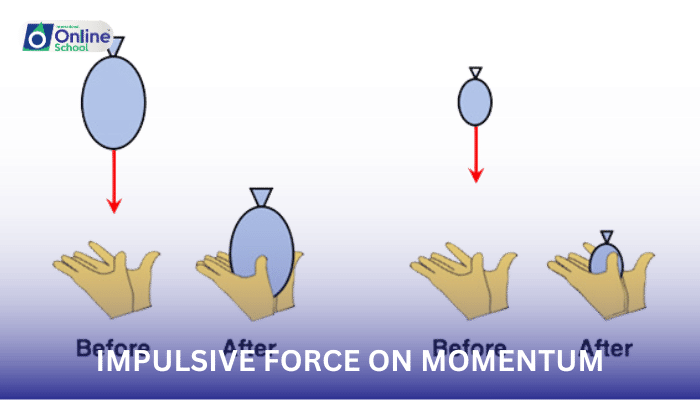
An impulsive force is a force that acts on an object for a short duration, typically much shorter than the object's natural response time. This forceful push, characterized by its high magnitude and short duration, can cause a significant change in the object's momentum.
ii. The Impulse-Momentum Connection: A Tale of Two Quantities
The change in momentum of an object is directly proportional to the impulse imparted on it. This relationship is mathematically expressed as:
Δp = FΔt
where:
- Δp is the change in the object's momentum
- F is the magnitude of the impulsive force
- Δt is the time interval over which the force acts
This equation highlights the profound influence of impulse on momentum changes. The greater the impulse, the more significant the alteration in an object's momentum.
iii.Factors Influencing the Momentum Change
The extent to which an impulsive force alters an object's momentum depends on three primary factors:
Magnitude of the Force: A stronger force acting on an object will impart a greater impulse, leading to a more pronounced change in momentum.
Duration of the Force: The longer the force acts on the object, the larger the impulse it imparts, resulting in a more substantial momentum change.
Mass of the Object: The mass of an object plays a crucial role in determining the change in momentum. A less massive object will experience a greater change in momentum for a given impulse compared to a more massive object.
iv. Applications of Impulsive Forces
The concept of impulsive forces and their impact on momentum finds numerous applications in various fields. In sports, for instance, players utilize impulsive forces to propel balls, bats, or other objects with considerable speed and accuracy. In engineering, impulse calculations are crucial for designing safety devices such as airbags and shock absorbers, minimizing the impact of collisions. In our daily lives, we encounter countless examples of impulsive forces, from catching a ball to stopping a moving cart, where these forces cause rapid changes in motion.
Example: Analyzing a Collision Using Impulse
Consider two cars colliding head-on. The impulsive force acting on each car during the collision can be approximated as the average force over the collision duration. Using this average force and the collision duration, we can calculate the impulse imparted on each car. This impulse, in turn, determines the change in momentum of each car, providing insights into the collision dynamics.
Impulsive forces play a significant role in shaping the motion of objects in the physical world. Their ability to cause rapid and substantial changes in momentum is evident in a wide range of phenomena, from collisions and impacts to everyday interactions with objects. Understanding the concept of impulse and its relationship to momentum allows us to analyze and predict the behavior of objects under the influence of impulsive forces, providing valuable insights into the dynamics of our world.
